 Christmas is not my favourite time of year. It never has been. Easter I love, and theologically speaking, that is the better choice. Handel’s Messiah was originally written for Easter. Really, it was. But Christmas hijacked it. And, along with overly-rich plum pudding, has become a “tradition.” “Bah Humbug,” I say. “Scrooge,” you may call me. But I am not Scrooge. I don’t want to be Bob Cratchit, Tiny Tim, the ghost of any Christmas or those dancing relatives either….in fact I don’t want to be any of those Victorians….and there it is! It isn’t that I don’t want Christmas, I don’t want Victorian Christmas. I don’t want Christmas cards (though I have sent them by the tonne in years past), I don’t want Christmas trees (though I have one this year and last year had 4! And I have an enormous collection of historical ornaments that would take several 12 foot trees to display completely), I don’t want overdone meals with desserts no one but me likes or insipid Christmas songs sung by pop stars (groan.) And I really, really, really don’t want anyone to tell me that any of the above has religious significance. Because it doesn’t. The Victorians reinvented what had been a pagan holiday in an effort to make themselves forget, albeit it briefly, that life was pretty horrible for most. I don’t want the desperate shopping (the Black Friday spending binge, is there really anything more repulsive) or the Coca-Cola Corporation’s fat, red Santa, or that hideous recent addition of The Elf on the Shelf (seriously?). And all that peace on earth blah, blah, blah is particularly disingenuous. You only have to look at one photo from Aleppo to see how little we mean any of those platitudes. All the faux seasonal joviality just makes a mockery of the reality of the state of the world.
Then there is the stress, the stress that comes with trying to live up to an unattainable level of perfection. Because a perfect Christmas is what we all want. What we all need. What we all have to have. Right? Just look at the packs of exhausted women and their overwrought children filling the pavements. The endless rounds of Christmas parties with burnt out colleagues. Extended family, under one roof, for days at a time. Or crushing loneliness.
 And it was in this state of unfestive gloom that I took myself up to York, my favourite English city after London, and realized it isn’t Christmas that I don’t want. It is Victorian Christmas I don’t want. But a Medieval Christmas, a proper yuletide festival, like the one I saw in York, with a modern twist, that would be ok. Fun and games led by self appointed Lords of Misrule and Abbots of Unreason and lazy time with family. Greenery, holly, ivy, box, laurel, yew brought in from the cold and lots and lots and lots of flowers. Flowers in red and white and gold spilling out of every container in every corner of the house. A permanently burning Yule log would be great, but probably not such a good idea in a no-longer working fireplace, so candles, a virtual log of candles. And lights on trees. Not trees that have been cut down and dragged into homes to die slow needle-dropping deaths, but glorious living, breathing, gigantic trees covered in electric colour.
 And for this, you can ask for no better place than Kew Gardens. In a moment of trying to plan something Christmassy, I had bought tickets to Christmas at Kew weeks earlier, something we had never been to before. I didn’t know what to expect. WOW. I should have known it would be fantastic. It is Kew Gardens after all. 300 acres of growing glory. The gardens are a wonderous, magical, fantasy land of light and shadow. And we walked through together as a family, a long walk, in the dark and the cold,
  looking at beautiful things. No gimmicks, just loveliness. We had a calm, happy, wonderful time.
What else would I want in my modern Medieval Christmas? Christmas crackers, Victorian I know, but I like the jokes. And I love carol concerts. So to my fantasy I add many, many sing-along carol concerts lead by gospel choirs in which the women wear angel wings. I will wear angel wings too. And will belt out every song that feels good to sing, seasonally appropriate or not. And our Lord of Misrule (my youngest would relish the role) will lead us in harmless fun without any deeper meaning or import than that it is a bit of joy at a dark time of year. And we will enjoy ourselves. And enjoy each other. Yes, I think that is the way forward.
So what about this Christmas story then? The one that has absolutely nothing to do with shopping and postage stamps and tediously long queues for everything and cakes that no one eats. The beautiful, simple tale of a teenage girl, pregnant and unmarried and her frightened young boyfriend, bringing a child into the world, not in December, more likely in the spring, in very unpromising circumstances. Yet this child becomes a figure of incredible influence. He changed the course of history. And offered the promise of a new humanity. Sadly, that hasn’t really worked out so well, we are just as awful as we ever were. The first 5 minutes of the BBC news this morning confirmed that: Aleppo, Berlin, big banks punished for their role in the financial crisis, pedophile football coaches, government snooping and this little beauty on the front page of the newspaper: “Civil servants who dole out foreign aid billions pay themselves more than any other ministry.”  For shame! The truth is, 2,000 years on we have a lot more Herod in us than shepherds or wise men. And that, my friends, is something we should think about every day of the year. Not just for Christmas.
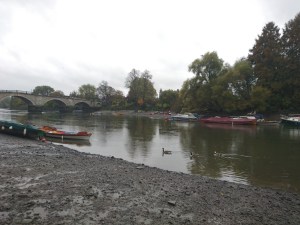 I love the Thames River. I have written before of this love, including post #12, Take me to the River, on the anniversary of Churchill’s funeral flotilla. I have travelled on the Thames and run along the Thames and crossed over it more times than I can count. I love to stop in the middle of the Millennium Bridge and admire London from every angle. Tower Bridge to the East. Southbank to the West. St Paul’s to the North and Tate Modern at the South. And then there is that scene from Harry Potter and the Half Blood Prince, when the dementors sweep and swoop through the bridge. It is a river so rich in history, with so many, many stories…. So when my girls’ school organized a river clean up, in Richmond, I signed us up, and immediately began dreaming of all the Roman coins I was going to find!
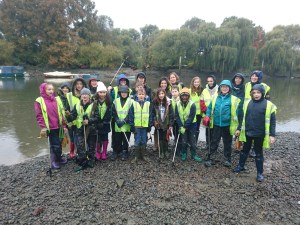 out. This make it the ideal time to do a good clean. Sadly, on the morning of our clean up, it had been raining for hours. And hours and hours and hours. It had been raining so hard for so long, that the river had refilled as fast as it had emptied. And it was still raining. The current was strong. Dangerously strong. But there we were. In our water proofs and wellies and gloves, clutching grabbers and bin bags. We were ready. We just needed to be cautious. And make sure our sense of humour was in full working order.
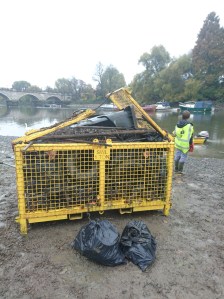 The good news is that the river, despite its appearance, wasn’t nearly as dirty as I expected it to be. No plastic bags at all, that bag tax must really be working. No fag ends, but then they do tend to disintegrate. Loads and loads and loads of glass. All kinds of glass. Bottle glass, wine glass glass, random rubbish glass. Even a pair of reading glasses. But then, just above that section of river sits a long line of upscale bars and restaurants. We also found pottery, some of it distinctly Victorian in style, sadly nothing Antiques Roadshow excitement old. Lots of t
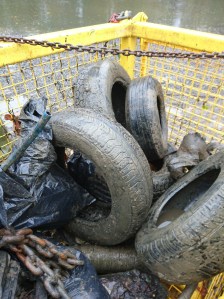 yres, blocks of concrete and metal rods. All of which we collected and dragged into a large rubbish container. When we finished, the cage was overflowing with our bounty. It was a happy sight indeed.
 Fair enough.
 We didn’t find any Roman coins, but a few from Brazil and Ukraine. We also found an empty ring box. Oh the stories we were able to spin from that combination.
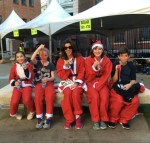 The British love to dress up. Any excuse will do. Fancy dress, as it is called, is a staple of the social scene, year round. Costumed runners have long been part of races of all lengths, especially for charitable fundraising. Why not combine the two? Not a great idea, so I thought. I am not a fan of dressing up for parties. I really don’t like dressing up to go running. But when in Rome, or London, to be exact…I have run in a bunny costume, particularly humiliating as it was after Easter so we all looked deranged. I have also run in a gorilla suit, much too hot and heavy to try again. In 2011, the older two children and I ran in a Nativity run. The remit was to dress as a Nativity character. I dug out a battered pair of wings from our dressing up box. My daughter wore a cape, crown and carried a box, a wiseman obviously. Joseph ran in his bathrobe holding a real hammer. He was Joseph because he is Joseph. The organizers seemed overwhelmed by this fact, as if he was in on a secret joke. They couldn’t stop mulling it over aloud, which was rather off putting. As I said, I’m not much for the costume runs. With one big exception. I have run in a Santa suit. Many, many times. Too many to count now. The Battersea Park Santa Run has been a fixture in my diary for years now, even when I wasn’t in a running frame of mind. Usually,
  I have been able to convince a child or two to tag along. Felt, one-size fits all, santa suits are distributed upon arrival at the start, which means we all look the same. For most, the suit is far too big, though occassionally there are matching child-size ones, ill-fitting in their own way, so we are rather a motley crew of santas. And the beards are horrible. But we are all willing. No one doesn’t wear the suit, and the few girls who show up in sexy elf suits just look like idiots. They are shunned by the pack. I love this race. For many reasons, but most especially for the looks on the young Battersea residents’ faces, staggering round the park in hopes of clearing their holiday overdosed heads, when suddenly one thousand (literally) santas come lumbering along….”I am still
  drunk” and “I’ve got to stop the recreational LSD” are but a few of the visible responses. We santas wave, we cheer, we photograph ourselves and others as slack jawed strangers try to settle their over-excited dogs. A perfect way to start the Christmas season!
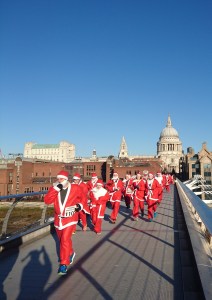 And what a glorious run it was. Starting from the north end of Millennium Bridge, a flood of red flowed, poured over my favourite bridge, much to the surprise of early morning strollers. We continued along past the Tate and the Globe, back across Southwark Bridge. Along the Thames Path the Shard and Tower Bridge came into sight, dodging tourists I drank deeply of this view I love so much.
  Through the hordes queuing to get into the Tower of London and then back along Fenchurch Street, through the festive Leadenhall Market and then the final bit, my beloved St Paul’s ahead, to the finish in Paternoster Square. The race was only 6k, yet it seemed to pass in seconds. And despite the cloying felt suit, I felt invincible. Yes, the world still exists with Syrian and Brexit and Trump and upcoming French elections and Italian referendum and Austrian vote (relieved to have just seen the result) and the youth football child abuse, but for a little bit of time, none of that mattered. Instead, my eyes and brain could only concentrate on things I love: art, theatre, history, Harry Potter, beauty. The things that keep us all going in troubled times. Running in the City, the city I love the most, it just might be what gets me through.
 I have seen the Harry Potter plays. Harry Potter and the Cursed Child. I took husband and children with me. We are all true believers. So when the great JK Rowling asked us (ok, not personally, but the HP community at large) to #keepthesecrets and NOT reveal anything about the plays we took that as an unbreakable edict. I won’t give anything away. But I will share the
 following:
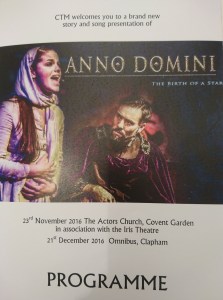 2016 has been a tough year. I’ve mentioned that often. And the result of the US election about did me in. Having said I was going to go to bed early, as I, like most of the world, thought I already knew the outcome, I ended up staying up all night, watching with shock. I stumbled bleary eyed and sad to the gym the next morning. “My wife has been crying for hours. And we aren’t American!” one of the lovely trainers told me. I felt defeated and drained. And fed up. I decided to turn my back on the world. Not the correct reaction, I know, but nothing seems to be right at the moment. Turn my back on the world, but a quick trip to the theatre first. For I had tickets for the Sam Wanamaker Playhouse to see a new version of Milton’s masque, Comus. The Globe, and it’s indoor theatre Sam Wanamaker, are places I consider to be sacred (posts #8 & 25 ), a refuge when everything seems wrong. I went alone, not sure that the exhausting combination of no sleep and reality wouldn’t send me straight back home. Instead, I sat mesmerized by the play, loving every word. And re-wrote my pledge. Not turn my back on the world, but move, at least temporarily, into a impenetrable bubble of culture. Went into a self-imposed exile, stayed off social media, and when I did engage with others it was only over art or theatre or anything Harry Potter. Even London herself was kept at a distance. I spent hours at home alone, finishing tasks I had started years earlier. I cleaned up rooms and cleared out closets and caught up on all the family holiday photo books. I was quiet and dull and looked at life only through the very hazy lenses of paint and poetry. And you know what, it has been bloody great. I think I am going to stick with this lifestyle a while longer. But London, knowing me as she does, has given me the occasional wink, the gently blown kiss, the silent connection. Because connection there still is, and connections, all round, there still are. On Wednesday afternoon I learned that my son Joseph’s wonderful trumpet teacher, Sandy Hooks, had not only written a Christmas musical, Anno Domini, but that it was being performed that night at St Paul’s Covent Garden, the Actor’s Church. I decided to go. And London smiled slyly.
 London has a gigantic pair of buttocks. Can any other city make this claim? I think not. My work here is done.
 Hamilton’s second room was filled with chastity belts. I have longed to write about chastity belts for ages. Because I know something about them most people don’t know, thanks to the hours I spent, several years ago, in the thorough and exquisitely detailed Museum of Torture, in a small town in Italy. Chastity belts are NOT instruments of oppression and torture and gruesome male dominance. Quite the opposite actually. As a medieval man, you would never have clapped your woman into a metal cage before riding off into battle. You would have hoped to have just impregnated her and to ultimately return, triumphant, to a healthy, male heir. Encasing potential mother and (boy) child would have been dangerous and counterproductive to this progenitive goal. Rather, chastity belts were something women put on themselves. When invaders arrived. Certainly more effective than a can of mace. And Hamilton’s belts are not menacing. Hanging like tiny child swings, decorated, some with flowers, they are pretty and playful and prohibitive. Not upsetting. Liberating. “My body, my choice,” in iron and leather and steel, with some lovely laser cut designs.
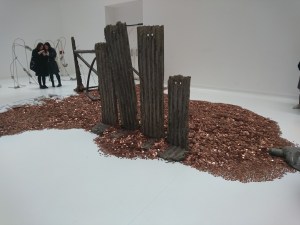 In total, 4 artists were on show. Michael Dean’s work included a large pool of 1 pence coins, UK poverty line of twenty thousand four hundred and thirty six pounds…, the amount being exactly 1p less than a family of four needs annually to stay above the poverty line in the UK. Suddenly the coins look very few indeed. The adorable little boy next to me shouted out” Mummy, can I have some money,” as he reached a chubby little hand out. “No, darling,” his mother answered. “No,” we all answered, in our heads, because there is already too little.
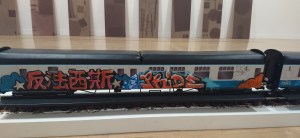 Josephine Pryde included a fantastic smallish train in her room, covered in graffiti from cities through which it has already travelled. Too bad we couldn’t actually hop on board. Helen Maarten takes objects from everyday life and re-assembles and displays them in new and unusual ways. I spend my days moving and re-assembling everyday objects. So I should have loved this work. But I seek art to escape.
 Who doesn’t love a celebration? Who doesn’t love a roaring fire? Who doesn’t love crazy fun things of a weekend? Oh London you just give and give and give. Though 350 years ago the mother of all fires took and took and took. As all year 2 school children know, the Great Fire of London broke out in a baker’s house on Pudding Lane, on 2 September, 1666. It had been a long, hot summer and the fire embers in a left-smoldering oven all too quickly turned into something completely out of control. It was so violent, ballads written after the fact described it as a demon, that “the fire flew with flaming feet,” the prevailing wisdom being that something so destructive had to be otherworldly. Slow response from authorities (the king said a woman could piss the fire out. Charming.) and strong winds allowed the fire to rage for 4 days, until the winds abated and the fire burnt itself out. Leaving a proper trail of destruction and misery. Yet out of the ashes……came 51 new Wren churches in addition to his great masterpiece, the still iconic St Paul’s cathedral. And a fabulous excuse for some fantastic installations 350 years on. It being London, it wasn’t just a rehash of Great Fire facts, but a starting point for interesting fire-esque fun.
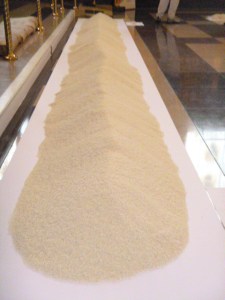 How do you celebrate an event that was so catastrophic at the time? By positioning it against other catastrophes perhaps, using grains of rice, in beautiful Middle Temple Hall. Of All the People in the World was a thoughtful installation of piles of rice, each grain representing one person. Stats on the Great Fire, of course, and the Great British Bake Off, not least because the Great Fire started in a baker’s shop. Brexit: votes in, votes out, and the equally large mound of those who didn’t bother. The number of current day refugees resulted in line of rice too long to photograph properly. As was the number of dead in one day at the Battle of the Somme. The number of female victims of domestic abuse in the UK in 2014 was unacceptably large. But so was the almost as large pile for the male victims. Not the equal opportunity we hope for, certainly. These were set alongside numbers from the Archers, the long running Radio 4 drama currently featuring a storyline on the subject. But these chilling facts aside, it wasn’t all depressing, state of the world stuff. I learned the number of people who have left their skull to science (1). And
 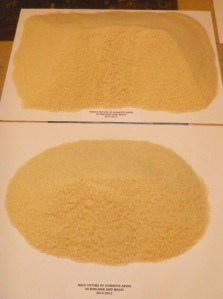 how many teachers Ireland could employ for a year if Google paid their tax (lots). What was the point of all of this? Not sure really, numbers in action, maybe, but I do enjoy a bit of juxtaposition in a stunning location.
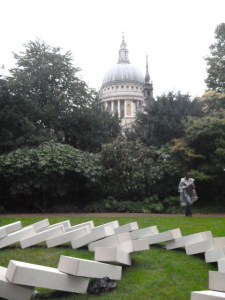 across from One New Change, oblivious to the crowds patiently waiting for some dominoes fun. There was a triumphal shout as one produced a 2/3 empty bottle of true plonk, now warm white wine they had clearly secreted away hours before….for reasons known only to them. It was then that they noticed the rather spectacular dominoes waiting to fall, and this startled them so much they ran off. The rest of us enjoyed a good ole self-righteous laugh at their expense. And then the blocks started to fall and we cheered and cheered. When it was all over the volunteers looked a bit glum. Because now they had to clear them all up. “Does anyone want to take some home?” one asked wearily…..well, I didn’t need to be asked twice. Heavy, wet and rather crumbly, my teenager daughter and I lugged one home each. On the Tube. Lots of stares and comments.
 But now they sit, at a jaunty angle, in my front room. Art! Of course it is!
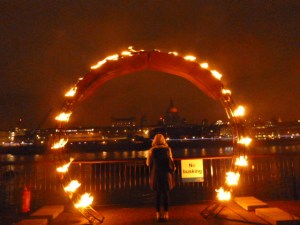 Throughout the weekend, a large and intricately carved model of the medieval City of London floated on the river, just across from Gabriel’s Wharf. On the Sunday evening, this structure was set on fire and allowed to burn away, the skyline of the new, shiny, tall, 21st century City of London visible further downstream. Resurgam. Out of the ashes. London. Always.
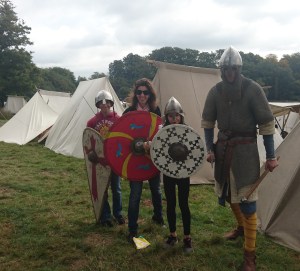 On Sunday, the children went with me on the train to Battle. To celebrate the 950
 And it would have been nothing short of churlish to refuse to celebrate the 950
 so well, it was easy to pretend that nothing much had happened in the intervening 950 years. The land itself is surprisingly, shockingly untouched. To imagine it as the great battlefield that changed the course of English history doesn’t take much work. Oooh, but to have it transformed into THE battlefield, now that was a true treat!
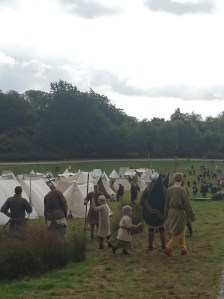 This make-believe was made all the easier with the re-enactors. Hundreds and hundreds of re-enactors. Their white, cloth tents picturesquely dotting the landscape and their impossibly adorable little children dashing about in costume, clutching bits of food their equally kitted out mothers had just whipped up on small fires. Who knew re-enacting was a family affair? For the men, with the armour and swords and beautiful, beautiful shields, this weekend must have been the highlight of their re-enacting lives. Why wouldn’t it be? Not only was it THE
 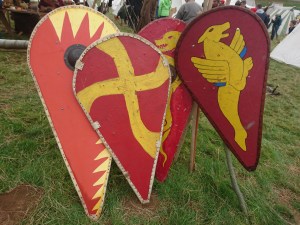 battle that changed the course of western history, it took place almost 1000 years ago. A Millennium. That doesn’t happen too often. And most of us won’t be around for the actual 1,000 year celebration, so good idea to make the most of this one. And they did. We did.
 In the Saxon camp English was spoken. In more regional accents than I could possibly identify. And such a visceral sense of camaraderie, laughter, singing and general feeling of good fun. You couldn’t help but feel envious of their involvement in such living history.
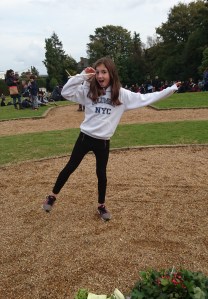 country for William. I convinced my youngest to do a little role play for the camera. The large stone tablet marking both the altar and the death spot was strewn with flowers. At first I thought perhaps people were still mourning Harold, but in fact the cards were in memory of re-enactors who were now playing on the big field upstairs. Some were quite touching. I suppose if this was your great passion in life, and I am ALL for passions, what better spot to be remembered than THE spot.
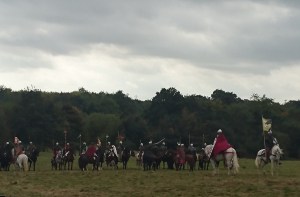
 sides. Cameras were held aloft. A hush of sorts fell. And at 3 o’clock it began. And what a superb spectacle it was!! Helmets glinting in the sun. Horses racing up and down the hill. Banners waving. The clank of steel on steel. The Normans got to run round a lot. The Saxons seemed to do a lot of just standing, which seemed much less fun. The “dead” lay still for a few moments before turning over and inching themselves along to get better views of the action. Boys and women rushed round with jugs of water for the fallen. For a while it all seemed rather chaotic. “What is happening?” I kept demanding of my children, who wisely ignored me. And then William, rumoured to be dead, rode
 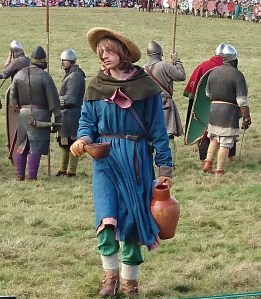 triumphantly by, helmet off, hair waving in the wind, proving to friends and enemies alike that he was still in it, and intended to win it. Things went rather badly for the Saxons after that. And suddenly it was all over. Or perhaps more accurately, suddenly it all began, for all primary school history lessons anyway. 14 October, 1066. It’s a new dawn, it’s a new day, it’s a new life…..and 950 years on we were all feeling pretty good.

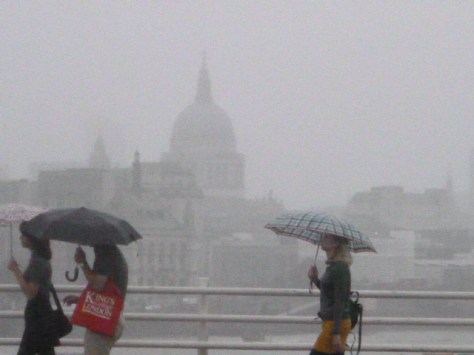 The Singing Bridge, part of the Totally Thames festival, is free, always a bonus. So, on this recent rainy Saturday afternoon, with my girls in tow, I gave it a go. And loved it. I loved Molitor’s voice and her narrative. I loved her compositions and that of the other musicians. Perhaps not to everyone’s taste, my girls weren’t so sure about all the pieces, but, for me, the ethereal, electronic, at times faux folk (is that an actual genre?) worked beautifully. I was completely of the moment with Waterloo Bridge and my youngest captured the magical nature of London and the Thames in the rain, all that tangible mist and shadow, on camera The walk begins at Somerset House, where you are handed
 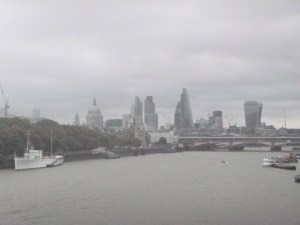 some large, trendy white headphones and a map, but are immediately told the route is optional. That said, you are crossing a bridge, so the options are limited. The idea is to slowly, thoughtfully and with a heightened sense of awareness cross Waterloo Bridge to the south, have a short stroll round the National Theatre and then back across the bridge. Normally, this can be done in about 15 minutes or less. Quite to my surprise, we took a bit longer than the 40 minutes of audio. Despite the weather and the
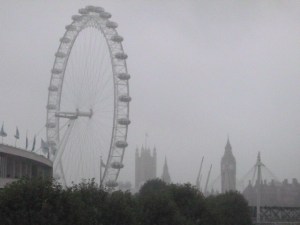 tourists and the crowds of charity walkers and runners, we dawdled with pleasure, refusing to let the frantic pace of London rush us along. Just as Molitor designed. You really do feel that you are looking at the city and the river with a detail you have never noticed before. It is an incredibly relaxing sensation. Romantic even.

 on Waterloo Bridge drawing the view, as Monet did more than 100 years earlier. I was a parent helper on this trip and was beside myself with joy at the sight of my American daughter drawing on Waterloo Bridge, like the famous French artist himself….the gorgeous cultural mix alone made me giddy. But of course Lizzie wasn’t really drawing as Monet had done, because it was a different bridge. Monet’s Waterloo Bridge was opened in 1817 but closed in 1924 due to disrepair. During WWII the bridge was rebuilt, by a mostly female work force, so it is referred to by people who know these things as the Ladies Bridge. Even better, the Portland stone cladding atop the reinforced concrete releases cleaning chemicals whenever it gets wet…as in whenever it rains. So it self-cleans. Now that is properly clever…well done ladies. It was also the first bridge in London to have electric lights. And it links Somerset House, home of art and ideas of every description, with the National Theatre, an institution dedicated to offering plays and musicals of the traditional and the modern in often new and unexpected ways. Two bastions of London culture, on either side of the mighty Thames, connected by Waterloo Bridge, which for the month of September, sings for you. What could be better?
 When the girls and I came up out of the Tube, rather wet but happier for our singing bridge experience, this notice greeted us in the ticket hall of our station. The opening stanza of The Water is Wide, a folk song covered by so many famous voices including Bob Dylan and James Taylor. Could there have been a more fitting note to this day. Thank you London.
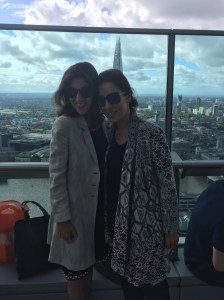 One of the great things about a birthday is that it focuses the mind. No, I don’t mean being overwhelmed with thoughts of the wretchedness of aging and death and how irritating accomplished 26 year olds are and does sitting in a cold chamber really remove wrinkles. I mean it gives one the excuse to do things you want to do but hadn’t otherwise gotten round to doing. “It is for my birthday,” is a very useful phrase when booking all sorts of self-indulgent outings. Especially, if, like me, you decide that a birth DAY is so limiting, better a birth WEEK. Come on, I made it this far in relatively one piece, I should be able to do better than a few witty cards and a slice of Sainsbury’s rose iced madeira cake (which was delicious by the way.) So I dug out my “things I should have already done in London” list and got busy. Top of that list (oh, a little pun there) was the Sky Garden. The beautiful, mostly enclosed botanical garden on the very top of the Walkie Talkie building, the one that set fire to things when it first opened in spring 2014. But I didn’t just want a
 quick dash up. I wanted to savour, relish the experience. And the security protocol is formidable, so might as well make it worthwhile. Most of all, I wanted to enjoy the Sky Garden before hoi polloi swarmed in with their buggies and backpacks and selfies. It was my birthday, after all. And I am an unrepentant snob, if you haven’t figured that out already. So I booked an early morning breakfast, at the cafe, and invited my gorgeous friend and frequent companion in all sorts of London adventures, Sara, to join as my “birthday treat.”
 We loved it. Being there early in the morning meant we had it almost to ourselves. We lounged elegantly on the blanket-strewn sofas with our coffees and grapefruit juices and admired our gorgeous city from on high, from all angles. The Shard looked particularly powerful and the rooftops of the older, shorter buildings are such a jigsaw of shapes and shadows I half expected to see free runners or secret lovers. The roof of the Walkie Talkie, officially 20 Fenchurch Street, designed by Rafael Vinoly, is a series of curved, glass panels, which were being carefully cleaned by a team of harnessed window washers on the morning. The light is extraordinary, constantly changing under the swift moving clouds and multi-coloured sky. Dutch 17th century painters,with their talent for painting sky in permanent transition, would have
  loved the space.
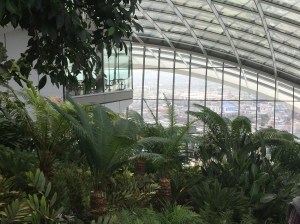 the cafe and swoop upwards, on either side, to a smaller, higher level, with a restaurant just above. The planting is beautiful and meticulous, segmented by water features, narrow pathways and hidden alcoves. It would be a fantastic place to have a party. London spreads out below you, yet, standing under the trees, you feel very far away from the hustle and bustle indeed.
 And then 10 o’clock came. The hordes arrived. The spell was broken. And we’d taken all the photos we wanted. So we left. But with plans to return. Soon. It is a rather lovely way to start a day, birthday or not.
 mylondonpassion