 April 23, 2016, St George’s Day, marked the 400th anniversary of Shakespeare’s death. And the 452nd anniversary of his birth. Because Shakespeare was clever enough to be born and die on the same day, that being the same day that honours the patron saint of England. Can’t make this stuff up. Being a Shakespeare devotee, but no scholar, I was excited to join in as many celebrations as logistically possible. In fact, I made it a long weekend of Shakespeare mania. But being me, it became a bit more.
I started the extravaganza with a day long course at the Victoria & Albert Museum, devoted (mostly) to the study of The Tempest, arguably one of the strangest and most difficult of plays. My children refer to it as “the weird one,” which is an ok description. I have NO formal Shakespeare education whatsoever. I rely on Google, Wikipedia, the knowledge of my English educated children and my own instinct when it comes to understanding the work of the world’s most famous playwright. Turns out, that isn’t always enough. The morning started well with none other than Dame Harriet Walter (saw her in a fantastic all female Henry IV) delivering a great Prospero-esque monologue. She was followed by Dr. Bridget Escolme who spoke eloquently on objects and costumes and sets in various Tempest productions, including the wacky film version starring (then) teenage pop star Toyah Willcox. She used lots of big words I didn’t understand, but her passion was infectious. After her came the American poet AE Stallings. Whose mind is so nimble she can flit from Shakespeare to Ovid to Virgil to Dido to Prospero to Lucretius to the tv show Lost and back again. As someone with NO background in the classics I could only sit in dizzy awe, and feel very uneducated, but in a lovely “tell me more, tell me more,” kind of way. I was mesmerized by them both.
High on these new crushes I wafted off to lunch in the gorgeous William Morris decorated V&A café, where, it being a rainy day, every tabled was packed. So I plunked myself down with two strangers….who were having the most marvelous conversation. I didn’t even try to hide my eavesdropping…. until I could take it no longer and just butted in. Fortunately one was American, so not offended, and the other was British, so too polite to admit offense. A costume historian/ripperologist from Chicago and an English writer. I was in heaven. Serious heaven. Especially when the chat moved to Deadwood, the best television after The Wire. With sadness I left my new best friends and returned to the lectures. I should have stayed and joined them on their pub crawl.
The afternoon was so over my head I took to scrawling “I have no idea what they are talking about” in my notebook, only to be followed with “now I REALLY have no idea what they are talking about” over and over again. Enthusiasm and a will to learn can only take you so far. Sometimes you do need the basic knowledge. And I didn’t have it. The final presentation was a Q&A with Toyah herself. As I didn’t grow up with her, I couldn’t join in the giddy excitement of my fellow attendees. That said, she looked great, wore a fabulous skirt and was very funny about the filming of the movie. On balance not a bad day. Actually, my new friends made it a great day. Thank you Alan and Karen.
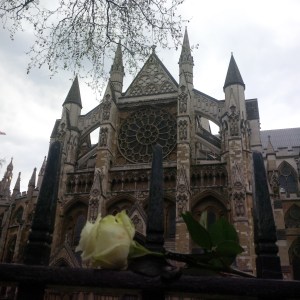 Saturday was the Sonnet Walk. I wrote last year of my love for this event (post #24 Reveling with Shakespeare,) walking round London, clutching a rose, waiting for strangers to jump out and quote Shakespeare. This year they held to the name and the actors mostly, but not always, delivered sonnets. The hilarious set up of the play within a play from Midsummer Night’s Dream and a gorgeously sung rendition
  of Double, Double, Toil & Trouble (Macbeth) from The Paddock Singers out of East Sussex being the exceptions.
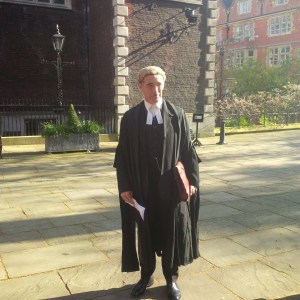
But never mind all of that. Because. At Middle Temple. Dressed as a barrister. MARK RYLANCE. The Oscar and BAFTA award winning actor. Former Artistic Director of The Globe. Mastermind of the sonnet walks. Yes, that man. Quoted Sonnet 46 and 47. “Mine eye and heart are at a mortal war….” We were like well behaved, non-screaming girls at a 1D concert….just shaking on the inside. With joy.
I have saved the best for last. Sunday. Hamlet. 2 years ago my daughter and I attended the premiere of the Hamlet that was to become Globe-to-Globe Hamlet at Middle Temple. It  was tremendous. What we said at the time is that it proved that Shakespeare doesn’t need updating or fancy sets or gimmicks. A couple of trunks, a clothes line and a few hats is enough. The words. THE WORDS (and some great acting) do the rest. We followed their travels on line. The quest to visit every country was foiled by N Korea. And some of the others had to be accomplished with a degree of inventiveness, if not outright moxy. Theatres, town squares, refugee camp tents….what an adventure. What an experience.
And two years on from our evening at Middle Temple we attended the penultimate Globe-to-Globe performance at, well…. The Globe. Happy for us, the cast was almost exactly the same as the previous. But what a difference. This was a performance that had become more than second nature, it had become owned. It was part of their very being. No line didn’t have relevance. No phrase wasn’t wise or funny or thought provoking or advancing. These were words spoken by true believers. Who had been round the world and back. And brought all that beautiful baggage and wisdom and experience with them. Does it get better than this? I don’t know. Does it matter? No. Because, because, because it proves that words matter. They matter very much indeed. And our ability to use these words to reach out over time and culture and language and make a connection….that is certainly something to celebrate!
Is there a lesson to be learned from this weekend! Yes. Yes there is. And here it is: Travel, enjoy Shakespeare (even if you don’t understand it all) and always talk to strangers. Because, to quote the great man himself, “The world is your oyster.”
Instagram & Twitter: @mylondonpassion
 The Chelsea Flower show. The scramble for tickets, the hype, the rumours, the controversy, the Queen’s nod of approval, the breath holding for medals, the summer dresses and the rain, so often the rain, No, I am not being sarcastic. Chelsea is all these things, and more. When Britain’s favourite hobby is given the royal treatment and the country is caught in an infectious grip of gardening fever. The King’s Road is busier during Chelsea week than at Christmas, as matrons from all over the nation pack the show in the morning, casting a discerning eye over new varieties and inventive landscaping and then flock to Peter Jones in the afternoon. It is a time when we all think we are all, if only briefly, seasoned gardeners with valid opinions on the work of professionals. I love the Chelsea Flower Show. I went the first year I moved to London. I was still in the early, queasy stages of pregnancy, the weather was cool and drizzly and the crowds rather overwhelmed me. But I loved it. And returned year after year. I even joined the RHS simply to be able to buy tickets for the slightly less busy Member’s Only Days. I often went with my friend Melanie and we walked and looked and talked. And talked and talked and talked and talked. One year we talked so much that we forgot to look at a single garden. Not a single one. We had to watch the Today at Chelsea
 highlights that evening just to come up with something to mention in the subsequent “how was it,” conversations. After that, I decided to take a few years off. Let my RHS membership lapse. Contented myself with the television round up during the week. Until this year, when I knew it was time to return. With Melanie. We would make an effort to see everything and eat ice cream. Which we did. On the most glorious of English spring days. Sunny, warm and beautiful. It was everything I hoped it would be. And more. Because this year it wasn’t a flower that stayed on our minds, but slavery. Yes, I said slavery. Sometimes a garden is more than a garden, sometimes it is a beautiful invitation to start a very difficult conversation.
 distance themselves from any suggestion of slave labour. This last bit is hoped to be accomplished with consumer pressure. Because, as the informative garden pamphlet states, “90% of change comes through people taking action. Only 10% by changing the law.” This means, we are all responsible. Quite a heavy message for one little garden to carry. But wow, it managed it. Beautifully.
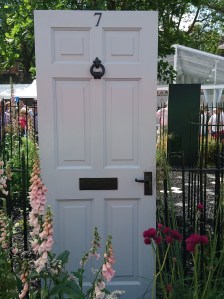 Familiar front doors with complimentary railings, looking so much like the entries to our own homes. But no one really knows what goes on behind doors, even well manicured doors with shiny knockers. And this is the point. Slavery is so often a hidden crime. 5,000 people are held in slavery in London alone. Of the estimated 27 million slaves in the world today, 14% are held in domestic slavery. A dear friend rescued a Phillipina woman years ago; it is a story that is uncomfortably familiar.
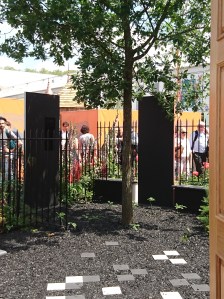 announced his intention to dedicate his life to ending the slave trade. Smaller oak seedlings were dotted round the garden, a tribute to those who continue Wilberforce’s work today.
 good seems worth a try. Who knows, it might actually work. And in years to come, we won’t need a gorgeous garden to remind us of a terrible truth. The Chelsea Flower Show: admire the plants, change the world. Fantastic!
 Somethings never change. Take this true tale of Constance Knollys. When her husband went away on business she bought the adjacent lot and, without bothering with pesky planning permission, built a walkway on the land. Seems a reasonable thing to do to me. No big deal, everybody does it, don’t they? Well, it turned out to be rather a big deal after all. The Knollys’ got into trouble with the City of London Corporation and were punished. Now, now, before you begin huffing and puffing about the nanny state and the EU, I must tell you that this all happened in 1381. 1381!!! And why am I bothering with this story at all? No, not to prove that we have always loved a good regulation (right as that might be) but because the punishment was so charming we still celebrate it today. The annual Knollys Rose Ceremony. A proper passion of mine.
 Lane, the same place, centuries on, that the famous diarist Samuel Pepys lived. Knollys’ wife, Constance, was known as formidable. My kind of woman. And she wanted what she wanted. A footbridge to take her from her house to her garden. That doesn’t seem much to ask. Oh, but she didn’t ask. And that got her in trouble. There is no record of how her husband reacted, but given that he was such a rich and successful citizen, the punishment was never going to be onerous. It was a fine of one red rose, cut from her garden, to be presented to the Lord Mayor, once a year on the feast of St. John the Baptist. Once a year. Every year. Forever. Seriously, forever. And for 600 years the ceremony remained. A rose was cut and presented. But then, as things often do, the tradition fell away. Until Tubby Clayton, the charismatic and ever-organizing Vicar of All Hallows by the Tower revived the ceremony between the world wars. Today, the Worshipful Company of Watermen and Lightermen, the guild that moves people and goods along the river, orchestrate the event; I don’t know why. But who doesn’t love a rower in full period dress.

 Many many many years ago, when my eldest was a tiny thing, I stood in a queue in an American shopping mall to “meet” Arthur, an aardvark off a children’s cartoon show. The queue was long and the other mothers were spiky, all eager that their little treasure have the best possible moment with Arthur. Unable to stand the tension, the frantic woman in front of me shouted to the girl managing the crowd, “will Arthur be signing autographs?” I will never forgot the sequence of expressions on the young handler’s face. From initial shock to bewilderment and then slowly, slowly, deep, deep pity. “Ummmm” she replied, speaking very calmly as if to an accident victim, “you are aware that this isn’t really Arthur. It is just a store employee in a costume.” Deep breath. “And he is wearing really big furry paws, so I don’t think he can hold a pen.” I dined out on this story for years. Yet, with each telling, I knew, in my heart, that it was only a very thin barrier keeping me from falling into this kind of insanity.
 The story of Henry V, with red balloons as soldiers, all crumpling latex when killed in battle. And most recently, both stories in the Greek season. Minotaur, done in the round with many of the younger audience as noble youths. And My Father: Odysseus. A set littered with modern day toys, hip hop at sometimes earsplitting volume, with a fantastic use of ketchup at the end. What isn’t to love.
 We all have hidden talents. I have many. And my skill at mini-golf came as a complete shock to my husband, when I finally revealed it after years of marriage. Ha ha, I know you were all hoping for something naughtier, but trust me, as someone with little concentration, less patience and absolutely no spatial relations what so ever, the fact that I am pretty good on a crazy golf course is a shocker. But I spent my adolescence in the mid-west where legal entertainment for teenagers is scarce. Putt putt, as we called it, was one of the few
  options. I suppose it proves that if you do something often enough you get good at it. I did and so I am. Mini golf has become a recent craze in London, but all courses are short term pop ups only (the exception being the soon-to-open course next to the Gherkin, which will be permanent.) And indoors. Always indoors. With bars. Certainly a different atmosphere to what I grew up with. I had to have a go.
 So I convinced Alice, my full time working in the City friend, to spend a beautiful, sunny London Friday afternoon in the underground gloom of the Truman Brewery playing at the Junkyard Golf Club. Properly decadent really. And we had the place practically to ourselves, which made it
  feel even creepier and skive-ier. But the emptiness allowed us to wander through all three courses and admire the “junk” put together not just to create obstacles but make you laugh. And we laughed a lot. Along with cast off appliances and quantities of neon paint was a speed boat carrying mannequins that must have spent time in a porn shop, given their attributes…we particularly liked the one wearing a boa made of fake dollar bills. Classy.

 Spring may be here. It is always a tentative thing on this fair isle. And it has been a funny year, weather wise. Balmy at Christmas, freezing winds and rain in the early new year, rain, rain, rain, rain, rain, rain, sunny in the mornings, ice cold by lunchtime, woolens, t-shirts, the full spectrum of British climate, and now a hint of spring. And daffodils. I wrote last year of my love for this most unique of flowers, with its funny happy face and sweet soft smell. It doesn’t offer itself year round, but jumps out, for a short time only, from what is oft unlikely and forsaken ground. Rarely alone, daffs like to sway in groups, not at all fussy about their surroundings. Gardens, traffic circles, tiny patches of earth between slabs of concrete. And then they go. But while they are here, I take advantage. I fill my house with them. I fill my milk bottles with them. Yes, I have milk bottles. Because I have a milkman. Who leaves pints of milk on my doorstep every morning but Wednesday and Sunday. He drives a funny, electric cart. I often hear it stopping, with a pnuematic whosh, on the road at some impossibly early hour of the morning. But sometimes the milk comes during waking hours. I could, if I wished, have a variety of items left with the milk: cheese, bread, vegetables, pretty much any cupboard staple. But the simplicity of the bottles, all in a row,
 on a frosty winter morning has become too iconic an image for me to ever tamper with, even for convenience sake. The one draw back of delivered milk is that it tends to have a shorter life than grocery story milk. This means there is sometimes frantic expiration date checking and wasteful pouring out, especially when something has happened to upset the delicate milk-use balance. Occasionally there is a thick stopper of cream in neck of the bottle. A few hard shakes usually does the trick. When I first moved to England a proper country matron told me how she would carefully remove this mass and serve it up to her children with fruit as cream. Yikes. The thought still makes me feel vaguely sick. Rather like eating the freezer burnt scraps of ice cream in an empty tub. But to each their own.
 My milkman is lovely. His name is Simon. He has never travelled to my country but would very much like to. He is knowledgeable about the current state of affairs there, always much to discuss with this presidential race going on. Well read too. He greeted me one morning with the question, “have you ever read Go Ask Alice?” Have I ever? A staple of my pre-teen years. How random. How divine. To talk about books on ones doorstep. I know his daughter enjoys outdoor adventure like abseiling and kayaking. He is always cheerful. And he delivers my milk. In gorgeous, traditional, glass milk bottles. Which, when empty, I leave out for him to collect….except for this time of year. When I keep back six, wash them up, and fill them with daffodils.
 The choir filed on stage, robotic in a delightful 80s music video sort of way. And then began the ballad no one has been able to resist of late….Ground Control to Major Tom…..and we were off. Crooning our little hearts out to Bowie, and Elton John and anyone else who had had the good sense t0 write a song about space. The accompaniment was organized by a Prince lookalike with ultra cool demenour. In complete contrast to the conductor. Young, female and blond, she put an aerobics instructor (still in the 80s theme…) to shame. She was pure energy, leaping, arms pumping the air, barely contained on her little platform.
  And when she sang the opening lines of “Fly Me to the Moon” in a rich, soulful voice..wow, passionate and talented. Fantastic.
 My first outing with SLR was on their Jack the Ripper night, a few weeks ago. A short run, in teams, through Spitalfields/WhiteChapel/City in pursuit of clues on the identity of Jack the Ripper. Actors (or long-suffering friends?) were scattered along the route, dressed in Victorian costume, ready to answer questions and direct or mis-direct inquiries. This should have been so my kind of thing. But at the very last minute, my only teammate and above mentioned Alice had a childcare crisis and couldn’t join me. When I finally arrived at the starting venue, a pub just off Petticoat Junction, the only other single runner was a woman who told me, but only once we were outside in the freezing cold!!, that she couldn’t run. Oh dear. Suddenly my running attire seemed woefully inadequate to cope with the weather. Because we walked. Slowly. It was bloody cold. I did try to get into the spirit of it as much as possible and, as we were now not really competing against other teams for times, I felt free to chat away to the Victorians as much as I liked. We were hardly going to get less cold or be any slower. This is how I know that the policeman at the Tower is from Ventura, CA and that pretending to sell oranges in front of the old Billingsgate Market is a cold and lonely prospect indeed.
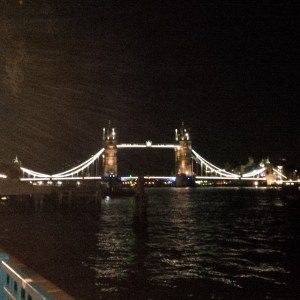 We didn’t guess the correct villain, but I did get some lovely photos of London at night, never can have too many of those, and had my circumstances been different, it would have been a fantastic night. I had to try again.
 One of the first stops was the ruins of Winchester Palace. London history can be dreadfully confusing, both chronologically and geographically. This is a good example. The Bishop of Winchester had his palace, not in Winchester (about 70 miles SW of London) but here on Bankside, between Southwark Cathedral and Clink Prison. The Bishops, down the ages, would have allowed prostitues to ply their trade in the area, but for a sizable fee. Extracting money from the desperate has always been a reliable money maker for those in power. But when they died, these same women were not given final rest on consecrated ground. Instead, they were buried at the Cross Bones Graveyard, along with plague victims and the general poor. A literal dumping ground for the unloved. A final insult to lives filled with injury.
 The land was closed to burial in 1853 on health grounds. It retreated into folk-lore and was then forgotten. Until London Underground started digging around in the 1990s. And historians realized what they had found: a tip filled with the unwanted of ages past. A garden of sorrow, if ever there was. Now the gates are covered in ribbons and it has become a quasi-shrine to remember the outcasts and unwanted of society, though increasingly it has become a place for people of all traditions to show respect and remembrance. Today, many of the ribbons are for people who are deeply loved and painfully, achingly missed.
 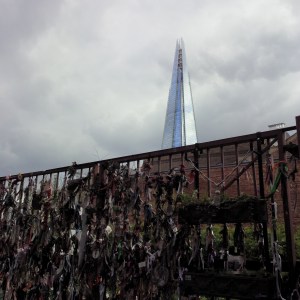 A baby, a young mother, a son. It is a wall of collective grief atop bodies for whom no grief was shown. With the iconic Shard looming overhead. Circle of life at its most theatrical.

 When the sun is shining there is no more beautiful place in the entire world than London. Perhaps it is because sunny days are not to be taken for granted on this northern isle, especially this spring. The weather has been fickle, to say the least. So, on Friday, when my frequent partner in adventure, Sara and I exited the Tube at Embankment, with the intention of visiting the Botticelli drawings at the Courtauld Gallery, we couldn’t bear to go inside “Let’s just stay outside a bit longer,” said Sara. So we walked through to the Somerset House terrace. The Thames was sparkling in the sunshine. The Eye was visible through the buds on the trees, framed by endless blue sky. London was aglow, as only London can be. Magic.
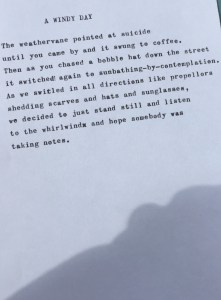
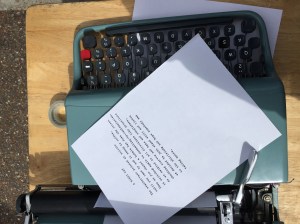 And there he was. Between the man blowing enormous bubbles and the musician. At his little table with his adorable green Olivetti typewriter sat writer and poet, Lewis Parker. I had heard rumour of him for years, but had yet to find him myself. His sign offered poems, stories and suicide notes (certainly not!), & more. We later found out later that the “more” tends to be resignation letters.
 “There he is, there he is,” I shouted at Sara, grabbing her arm excitedly, like a crazed pop fan or royal family devotee. If she was surprised that the object of my enthusiasm was a young, serious man with typewriter, she didn’t let on. She knows me well, after all.
 With the trees rustling and bending in the increasingly strong wind. Daydreaming. Nowhere else on earth I would have rather been at that moment.
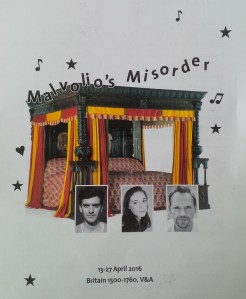 April has arrived and with it the start of what is going to be a London love-in of all things Shakespeare. This month marks the 400
 So large it could hold 4 couples at the same time. A faded painting on the headboard suggests what all those bodies could have been up to…coitus interruptus by means of Malvolio. He is horrified Maria is discussing this racy item and hurries us into yet another room, to show off a fireplace and a ceiling. But we don’t really get to admire these blander fixtures as immediately he is overtaken by Toby. And then the fun starts. A back and forth and round again between all 3 characters. A song. More badinage. The famous yellow stockings. No, they didn’t speak Shakespeare’s words, Yes, you needed to know the play to appreciate all the jokes, but it is such a playful and fast romp it didn’t require any in depth knowledge. Why do you tease me so, whinges Malvolio. Because “you delight in others misfortunes.” And this afternoon we also delighted in Malvolio’s misfortune. After being invited to join a lovely rendition of With Hey, Ho, the wind and the rain (a familiar ditty to any as dedicated to the Globe as me), Malvolio staggers off. Howling. In self-pity. A thoroughly entertaining 35 minutes. If only all museum tours could be so engaging. Shakespeare and the V&A. Great combination.
 mylondonpassion