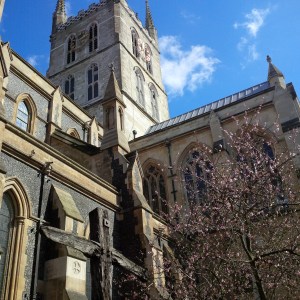
 Today is Good Friday. As I wrote last year, this is my favourite day in the Christian calendar. Not for me the Victorian inspired Christmas traditions of mock mirth and grinding but pointless work for Mummy. Give me some proper pain and suffering. Whether you have a faith or not, the acknowledgment, the celebration of a horrific act of torture is an opportunity for reflection. Self-reflection, global reflection and that most first world of all first world problems, asking yourself, “what I am doing with my life?” If you live in London, there is the chance to do all of this in a stunning 1,000 year old cathedral on the river Thames. Attending the Passion of Good Friday at Southwark Cathedral has become a tradition for me. (see post #18, Good Friday and Yoga.) What has also become a tradition is that the method through which the passion story is explained is, if not an all out zeitgeist, at least something that seems to be directed at me personally. Yes, you may consider this to be the ranting of someone utterly self-absorbed. But I have often said that I believe my relationship with London to be a living entity and so I don’t believe in coincidences, only reactions. So when London speaks I listen. And obey. And she is saying “poetry, my passionate one, more poetry.”
Poetry is something that has been on my mind a lot, for several years. Because I desperately want to be someone who knows, reads, understands, quotes and, dare I dream?, writes poetry. But I am not. I didn’t study it at school, didn’t go to that kind of school. Instead, like Shakespeare, it is something I have been drawn to and absorbed on my own. An imperfect collection of knowledge from a bizarre variety of sources. But an exciting exploration. And today was all about poetry, led by the Chancellor of my own St. Paul’s Cathedral across the river, Mark Oakley. In the service, through a series of readings and addresses, Canon Oakley explained how poetry has been used, from as far back as Anglo-Saxon times, to describe not just Christ’s crucifixion but the loss and pain and sorrow that is part of being human. Because if any platform can encapsulate suffering, it is poetry. Read aloud. Definitely read aloud.
Like all girls of my time, I received my copy of Sylvia Plath’s The Bell Jar from my mother with solemn joy. And devoured it. Over and over again.  And then her poetry. I have all the books. Some poems I love, but many I find baffling. Over a Bank Holiday weekend in May, in 2013, at Royal Festival Hall, 40 of the UKs leading female poets and performers, including Anna Chancellor, Samantha Bond and Miranda Richardson, read one poem each from her posthumous collection, Ariel. And the packed concert hall was stunned into 80 minutes of beautiful, painful silence. Her poetry is so strong and raw and powerful on the subjects of disappointment, betrayal, and despair. Words made flesh.
At a fantastic party, last November, our host, after much wine, rose and insisted we all recite our favourite poem. He turned to me first. And I had to confess I had no memorized poetry to offer. He was shocked. Horrified. And then treated us all to the best of the British Romantics before sharing his own recently written ode to the genius of Oscar Wilde. I was amazed and transfixed and very very envious. The Tube has been running Poetry on the Underground for 30 years. I read them all. Some make me smile, others don’t interest me…and some resonate. Grace Nichols, Like a Beacon is my favourite because I know the shock that can be homesickness. And how it can catch you off guard, at unexpected moments.
In London
every now and then
I get this craving
for my mother’s food
I leave art galleries
in search of plaintains
saltfish/sweet potatoes
I need this link
I need this touch
of home
swinging in my bag
like a beacon
against the cold
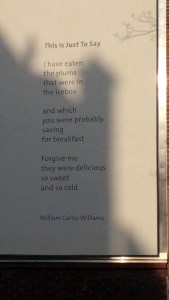 In one of my many NYC apartments one of my many roommates taped the William Carlos Williams poem about the plums to the front of the fridge. I think she did it less as a warning than a bit of pretension. Last spring I saw it, in enormous lettering on the side of a house in The Hague, near were I had once lived. No longer just a poem but a conduit to memories of former lives.
And so back to today. From the 8th century, a poem, from the point of view of the tree on which Christ was killed.
“They mocked us both, we two together. All wet with blood I was,
poured out from that Man’s side, after ghost he gave up.”
And then a medieval poem. Read in Middle English (with a translation along side) all about love.
“Love brought me
And love wrought me,
To be, man, your friend.
Love fed me
and love led me
And love kept me here.”
And then Emily Dickinson. The famously reclusive 19th century American poet, who asks: is your grief greater than mine, and will it ever go away? The answer, sadly, is no.
“To note the fashions-of the Cross-
And how they’re mostly worn-
Still fascinated to presume
That some-are like My Own-”
It isn’t an uplifting poem, but then Good Friday isn’t an uplifting day. It is a day for sorrow. In a world with endless sorrow. With poets to describe this sorrow.
Last week I was invited for a drink at one of London’s exclusive clubs. Gorgeous building, incredible art and a sign that suggested had I turned up 2 hours earlier I could have attended the Poetry Society meeting. How did I miss this, I asked my host? He frowned, but was diplomatically silent. I think the telepathic message was, you need to have something to offer. Which I don’t.
I have been told that there is a man who will write a poem on the spot, for a fee, on the Southbank. I have yet to meet him. But anxious to do so. If anyone knows how to find him, please let me know. London has clearly given me a mandate. By this time next year I should be able to rattle off something on demand, maybe something thoughtful and contemporary, maybe even something funny and happy, because after Good Friday comes Easter: hope, chocolate, bunnies and Easter shoes (yes, that is a thing. I have two pairs.)
How do I begin? I have found a small volume entitled: Auden, A Collection on a shelf in my bedroom. I shall start there. So if any of you see a little dark haired woman on the Tube reading poetry, it may be me. But hey, this is London. It could be someone else. It could be a poet.
 Some of the best ideas are the simple ones. Want to share a fav film with friends? Tack up a sheet in a London garden, crack open some beers and let Backyard Cinema be born. 4 years on, these are the perfect people to host Shakespeare’s classic tale reworked for the MTV generation. This spring not only marks the 20th anniversary of Baz Juhrmann’s Romeo+Juliet…how can it have been that long! It is also the 400th anniversary of Shakespeare’s death. And London has great plans in store. So what better way to start my own Shakespeare-adoring fest than here, on a comfy couch, generously poured G&T in hand, in the beautiful St Mary’s Church in Marylebone, which has been decorated to resemble the church in the film. And a choir. A real choir.
  Some Voices Sing Choir. Oooh what a choir. Backyard Cinema, you are genius. But then you are London.
 And tonight we get it all, with a choir. As the previously boisterous crowd quiets, and the newscaster explains “In fair Verona, where we lay our scene…..a pair of star cross’d lovers take their life,” the choir, in red robes, holding candles, processes, and in full operatic voice begin “Oh Verona.” Mesmerizing.

 Two years ago at about this time of year, my younger son Stephen and I fell into a shortlived but lovely habit of running to Brixton; it is exactly 4 miles from my home. two rights and a left. We would have a good look through the market, visit the KnightWebb art gallery, an impossibly tiny place filled with fabulous things (I long for one of Rufus Knight-Webb’s sculptures of recovered treasures from the Thames) and take the Tube home, laden with treats. Sweets, unusual vegetables, Spanish ham, and best of all, Auntie Roslyn’s banana cake. I remember dancing to Eddy Grant’s Electric Avenue as a child. To stand on Electric Avenue now is a thrill. Once I made Stephen cross over the high street to see the Bowie mural. He was unimpressed. However, in January, when this mural became
  destination-most-necessary following David Bowie’s death, Stephen was rather pleased to be able to say to his classmates, “yeah, I know where it is. Already been there.”
 Brixton is home to both an O2 and the Electric, small venues perfect for non-stadium gigs. Kate Tempest, the Queen of the spoken word, cut her teeth performing in Brixton. I was lucky enough to catch her local-girl-done-good show at the Electric, last February. Angry, passionate, funny, eloquent. My kind of girl. Brixton’s kind of girl.


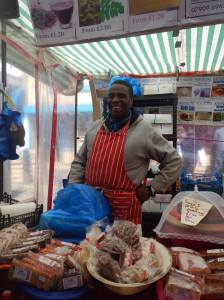 wasn’t a whole banana cake left for me to buy, “have to get here early, love,” a passer by told me. But, with the encouragement of everyone who happened to be standing round, the stall owner managed to find, within baskets and boxes stashed all round the tiny tent, 12 sections. A whole cake after all.
 I used to be a star letter writer. When I was a child I had more pen pals than I could sensibly handle. I enjoyed a long correspondence with my maternal grandfather, George, throughout my early adolescence. At the back of the drawer that holds my prettiest, laciest treats is a stack of letters, tied up in a pink bow. No, not passionate messages from a long ago lover, but chatty, honest letters from my best friend from university, Abby. The two of us wrote constantly back and forth in the first years of our marriages and the pregnancies and births of our first babies. They are funny and silly and sometimes desperate. But lovely. I have kept them with the thought of returning them to her one day. But she married a bad man. And some of the anecdotes, read with hindsight, are frightening hints of what is to come. So I don’t think she will ever want them back. But yet I keep them. Because they are letters to me from someone who loves me. And that is something worth keeping, even if much of the content is about how to get babies to sleep through the night.
 Letters Live at gorgeous Freemason’s Hall near Covent Garden was a delight for the eye and the ear and, most of all, the heart. Letters, some famous, some private, read aloud by well known actors and others. This is sooooo my kind of thing. Turns out, it is a lot of other people’s kind of thing too. But then this is London. Home to the fabulous. The Grand Hall was packed. We sat entranced. Sometimes we laughed. A lot. Plenty of tears as well. Tom Odell played the piano, twice. And a young woman whose name I don’t know played the cello. She had recently won an award. Can’t remember which one. Maddeningly, there was no program. I tried to hastily write readers names down on the back of a Waitrose receipt I found in my purse. But it is not complete. And despite believing that I would never forget a single word of any of it, within minutes of leaving the venue I was already confused as to who had read what. I blame this, obviously NOT on age or wine, but on the fact that my senses were so supremely overloaded in the most marvelous way, I had no ability to remember details. Or at least not all the details. Some happily have stuck. Bob Geldof’s lusty reading of Sol de Witt’s letter to Eve Hesse, urging her not to give up but instead to “just do.” Later in the evening he read his own letter to the council in response to a complaint from his neighbour about the wildness of his garden. Hilarious, obviously, and we were all left with a deep longing for the woman’s tidy AstroTurf to be littered with pollen and leaves forever more. Toby Stephens read the letter from Mark David Chapman to a collectibles dealer about the potential value of the album John Lennon had signed for him only hours before Chapman shot him. The heartlessness of it all was chilling. This was immediately followed by Dame Harriet Walter as Yoko One, responding to the state of New York on Chapman’s request for parole. Heartfelt and so very very sad. My teenager daughter asked me a few days ago why “everyone” hates Yoko One. I trotted out the usual “broke up the Beatles” line and then stopped, and answered honestly, that I didn’t know. Sure, you can dislike her music and her art, but people don’t dislike what she produces. They HATE her for being her. Which is awful. And this letter, so full of sorrow and humanity. “My husband did not deserve this,” she wrote the parole board. Either did she, for that matter.
 People began photographing and taking videos of the man and his parrot. The man was positively beaming and the parrot hopped energetically from his shoulder to his arm to his hand and back again. Once on the train, the parrot clenched the bar in its beak and held on like a seasoned Northern Line commuter. The passengers loved it. Except for the poor girl with the dog. The dog was going insane. An actual winged creature in an enclosed space, better than 50 squirrels up a tree! It was all she could do to keep hold of the lead. She looked very stressed and wasn’t at all amused when the man started to bring the parrot closer to her frantic hound. “No, no please please don’t” she implored. The rest of us thought it was great. And then he got off at Waterloo. The moment was over. The carriage went quiet. But we all kept smiling at each other because we had all just seen a parrot on the Tube!!
 My fabulous friend Lucy, while carrying a hula hoop, as one does, performed a spontaneous dance with a Charlie Chaplin look-alike on the Northern Line. Silently, obviously. About 18 months ago I travelled on the Northern Line in a gorilla costume. A proper, serious, full on gorilla costume. I was on my way to a charity run. For gorillas. No one even glanced at me. On the return trip I carried the furry costume, medal proudly slung round my neck, and that got strangers interested. A good looking young man was particularly eager to start up a conversation, asking me all about the costume and the run and other races I had done.
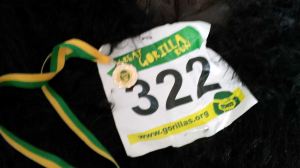 I was feeling quite flattered by the attention. And then he said it, “Oh my Mum does all sorts of crazy stuff like that too. It’s great..” And I felt…jubilant. No really, I did. To hear a child, no matter the age, express appreciation for something their mother does, especially something slightly off beat, is to be treasured. Perhaps that is why the incident came back to me today of all days, International Women’s Day, two days after British Mother’s Day. In general, I have little time for such “Days.” Sadly, we live in a world were the lives of millions of women are grim, if not downright hideous, and no amount of special mentions or flowers is going to change that. However, saying something nice about your mother on public transport is a good start to making the world a better place. Seeing a parrot on the underground is pretty good too. Happy Day.
 I believe in lots of things. Love, the kindness of strangers, the power of art, the magic of the ordinary and connections. Connections most of all. I see them everywhere. I experience them constantly. I would love to say something like: when I stand very still I see the universe weaving her complicated web of connections. But I don’t stand very still, ever. Or rarely ever. Instead, I toss myself headlong into the day. Maybe it is for this reason that connections continue to catch me out, surprise me. The unexpected delights me. For example, the delight of a day that starts out as normal (whatever that means), then takes a few turns and suddenly I find myself being driven to the Tube station by none other than artists Gavin Turk and Deborah Curtis. They are not just world famous, influential artists, but serious game changers in the creative world. And we talked about art!!!…if only my 17 year old self could see me now….wait, wait, let me try to find some sort of beginning to this tale.
 During the London 2012 Olympics, I was filled with even more love for London than usual coupled with a general, overwhelming love for my fellow human beings. Under the spell of all this tenderness, I noticed Tracey Emin’s poster for the Paralympics. An artist I had previously dismissed for her drunken buffoonery had produced, to my eyes, something of exquisite and tender beauty. I was entranced. Then came the neon signs, with all their vulnerable romanticism. I adore them. In Las Vegas, in order to see her signs at their best vantage, I braved a rooftop bar/pool that was like a scene from the In-
 Betweeners film, such is my devotion. When Tate Britain announced that My Bed was back on display I rushed over. And have returned many times. How could I have not gotten it before? Never mind the filth and the rubbish and the morning after pills. This is a work of heartbreak. Perhaps it should be called “what was will never be again.” I know everyone focuses on the dirty sheets and vodka bottles, but it is so so much more than that. It is the debris of paralyzing depression. The I-have-no-reason-to-get-up-ever-again misery, in all its cheap, crumpled loo roll as tissues and over the counter pain relief pop outs and plain “I No Longer Care” grime. I love it.
 Complete with fags and pills and tights. I had to have it. HAD TO!!! It wasn’t for sale as such, instead, an item in a silent auction for the charity, The House of Fairytales. Founded by Deborah Curtis, artist (and wife of Gavin Turk), it is a national organization aimed at making the arts, and the creative learning that goes with art, available to children of all backgrounds. I hurriedly scrawled a bid, then went in search of the artist who had created it, not Emin herself, obviously, but equally obviously, a fellow fan. And find her I did. On Stand #15. JanaNicole. American. An artist of gorgeous, vibrant, clever, often nostalgic mixed media pieces who lives in a stunning part of England with her young family, near a haven for opera fans….oh the conversation bubbled with enthusiasm and shared passions. She sounded so much like me. In fact, there was something about her that seemed particularly familiar, not just our accents, not just our ages….when we finally got round to the “ok, where are you from…” stage of the chat I think we both knew what was coming…oh yes, though she claims Southern California on her resume, she spent a few years in the next school district over from me (a much posher one) in the mid-West, a place her father still lives. We probably went to the same parties. Would we have recognized the “I must get out of here” desperation in each other had we met then? Possibly not, but nothing like a proper anywhere-but-there rant to bond two people. Now I was determined to win the bed. Her bed. My bed.
 Young British Artists, or YBAs as they are more often known, brash, bold, barrier breakers who began to exhibit together in London at the end of the 1980s. People like Damien Hirst and the above mentioned Tracey Emin. Love ’em or hate ’em, these guys put British art back on the international map. Turk, who famously created his own Blue Heritage Plague as his graduation exhibition, often explores the ideas of identity and authenticity, including everyday objects in painted bronze. My personal favourite is Nail in One New Change, in the City, perhaps a nod to the fact that this extraordinary building of steel and glass was built completely without such tools.
 Pithy “thoughts of the day” and classical music greet me at some of my favourite stations. Books are often free to take at Clapham North.
  On an early Sunday morning I watched a man create and then tie balloon animals to the poles in my carriage before leaping out of the doors. A lovely, random act of fun for the Northern Line traveler.
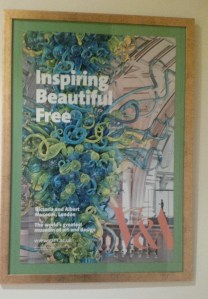 And where would I be without all those posters with the latest cultural offerings. I depend on them. Some of them I grow very fond of. I loved the V&A poster with the Chohuly chandelier so much I spent years and years trying to get a copy for myself. After much persistence I did it. It hangs, in a gold frame, outside my kitchen.
 There is nothing I love more than the random encounter, like the kind I had a week or so ago post theatre. On the Northern Line hurtling home, two young men sat across from me. One was drinking beer from a beer glass. Drinking on the Tube is illegal, by the way, so it is usually done furtively. But he rested his glass boldly on his knee between sips. I couldn’t resist, “I admire that,” I said, nodding at the glass. They looked aghast, an old woman was speaking to them. On the Tube. The horror! Undaunted, I continued, “drinking a beer on the tube, and from a real glass.” They relaxed and smiled. “Yeah,” said the one with the drink, “I brought it from home.” And that was my cue to produce a plastic wine glass from my purse. They were astounded, delighted. Photos were taken (by them!) I didn’t tell them I had just come from one of the theatres with the new, fabulous, plastic wine glass policy, just let them believe that I travel the city prepared for wine at a moment’s notice, including on the Tube. The boys told me they had been to a celebration, “of sorts,” but there was something glum about the way they said it. So maybe the happiness didn’t include them? Like that story line from Love Actually with Keira Knightley and the two friends. Or maybe…well the truth doesn’t really matter because their story is now my story, and I can spin it any way I wish. And that is the generosity of the Northern Line. It not only takes me everywhere I wish to be, but gives me plenty to fire up the imagination as I go.
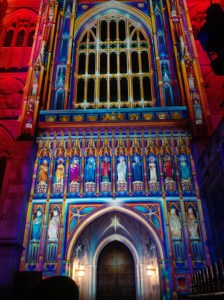 I don’t believe in New Year Resolutions because January is such a dreary, worn out month. Change doesn’t happen because of a calendar, it happens because we crave it, want it, need it, will die without it. But never does it have anything to do with it being January. It isn’t January’s fault it gets saddled with this burden of a new start, and it just isn’t up to the task. It is cold and wet and grey and broke and tired. The last thing it wants to do is try to transform lazy, disinterested people into svelte, well read, paragons of culture and intelligent thought, knowing that all we want to do is spend the month in bed listening to the Archers.


 My personal favourites were the human figures floating in the air and perched on window ledges in St. James’s Square. Eery, beautiful, haunting. Like angels or spectres or dreams.
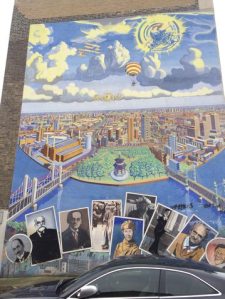 Treats, as we know, come in many sizes. London often serves them up big. Enormous, crowd pleasing, hot ticket items: Alexander McQueen, Dominic West in Les Liaisons Dangereuses, New Year’s Eve fireworks. But there are plenty of little treasures that require only admiring eyes and, in my case, a pair of good walking boots. And so with an adventurous spirit, a good friend and relief that the rain had taken a brief break, off we set for a stroll through Battersea. There, tucked away on a small street, we found the magnificent Battersea In Perspective. A mural, painted by Brian Barnes in 1988, of Battersea big shots and progressive thinkers from the early part of the previous century. John Archer, London’s first black mayor, said, when he took office in 1913, that the world “will look at Battersea and say, “It is the greatest thing you have done. You have shown that you have no racial prejudice.” Charlotte Depard, activist, fought to have women from the sweatshops included in the suffragette movement, a mostly middle class concern.
  When the vote was finally won, she continued to work on behalf of the poor, especially women, and opened her home to the community providing meals and a drop-in clinic for those in need. John Burns, a politician and Britain’s first working-class cabinet minister, was instrumental in the creation of Latchmere Estate. Whatever we may think of estates like this today, back then they allowed working class families to escape slum landlords, whose properties were often unsanitary and dangerous. Hilda Hewlett, born in Vauxhall (guess that is close enough to Battersea to count), became Britain’s first female pilot. Alliott Verdon Roe started his aircraft manufacturing company, AV Roe & Co, in 1910, in a Battersea railway arch. Eustance and Oswald Short also started their aircraft manufacturing business, Short Brothers, in a Battersea railway arch, and one of their gas balloons, built in 1908 or so, is featured at the top of the mural. Also pictured is the Battersea Power Station, the Peace Pagoda, Chelsea and Battersea Bridges and of course the park itself.
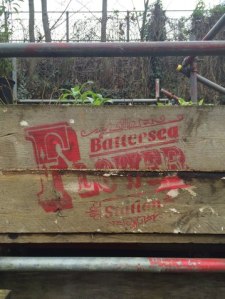 Our second find was only a short walk but whole world away. The sweetly named Battersea Flower Station, squeezed into an alley along railway tracks, is easy to miss. A garden center that uses the awkwardness of the space and debris of the city to best advantage. Friendly staff and curious plants, the kind of place that makes me think I might take up gardening, if only I had any knack for it.
  I was, however, inspired by the Moshi Monsters set in concrete slab. Now that is a project I could embrace, given the number of plastic creatures I still have in my basement. Even on a cold, dreary, January day this little gem has a certain magic…..
 I am an unrepentant theatre addict. There are so many things about London theatre I love, to list them all would be exhausting, and a few things that simply must be endured, the impossibly small and improbably located ladies rooms’, for example. And the flimsy, but lip-slicing rimmed plastic cups one must suffer if one wishes to enjoy a glug or two of enamel-removing, warm white wine during the production, which, of course, I do. But London has now decided I deserve better. I went to the theatre two nights ago and was given the plonk in a REAL wine glass. Ok, it was plastic, but it was big, wine glass shaped, gentle edged plastic. I was amazed and delighted and of course I took it home! Last night I went to the theatre again, I am an addict after all, and the same thing happened!!! What, I demanded of the bar staff, was going on? The young girl shrugged and said, “dunno, Nimax theatre.” which enlightened me not one little bit. …a quick Google search later and I am ready to tell all. Nimax Theatres are a collection of 6 London theatres (Palace, Lyric, Vaudeville, Duchess, Apollo and Garrick) owned by Nica Burns (actress, producer, artistic director) and Max Weitzenhoffer (equally impressive resume from New York)….NiMax…get it? And clearly these two titans of the stage have decided to up the game with proper wine glasses, of the plastic variety. I could not be more pleased, and not just for the pleasure on the night. I did already confess that I took both glasses home. Because I need them. Wine glasses of the traditional material come into my home to break. All of them. Only took a few years to get through the 24 wedding gift Waterfords. The smaller collection of Baccarats went next. The slightly more affordable Williams Sonoma goblets managed to hang on for a while, then the John Lewis ones came and went…by last summer I was back down to a single wine glass. Fine as far as I was concerned, though guests sometimes looked surprised when offered a nice sauv blanc in a mug, but being English they never complained. At Christmas time, having invited the extended family, I picked up a few at Sainsburys, but they didn’t stick round long. I know it sounds like we host bacchanalian orgies where everyone smashes their glasses to the floor with triumphant hoots and hollers. In truth, the accidents happen in the boring washing up stage. The combination of hot water and porcelain just does them in. And now I have the answer!!! I am going to build up such a collection of beautiful plastic wine glasses from the theatre. What a genius plan.
 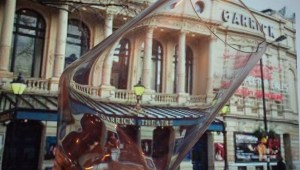 And the next time someone in the family says, “you are going to the theatre AGAIN,” I will respond, in a self-righteous tone, “yes, but I am doing it for the good of the home, for the wine glasses.” That should convince them!
 mylondonpassion